Planning the best time to visit Mongolia starts with the journey you want, rather than one nationwide weather average. A short escape around Ulaanbaatar, a Gobi road trip and a northern lake journey do not have identical seasons. The right dates also depend on how comfortably you sleep in a ger, how much driving you enjoy and whether a festival is the reason for your trip.
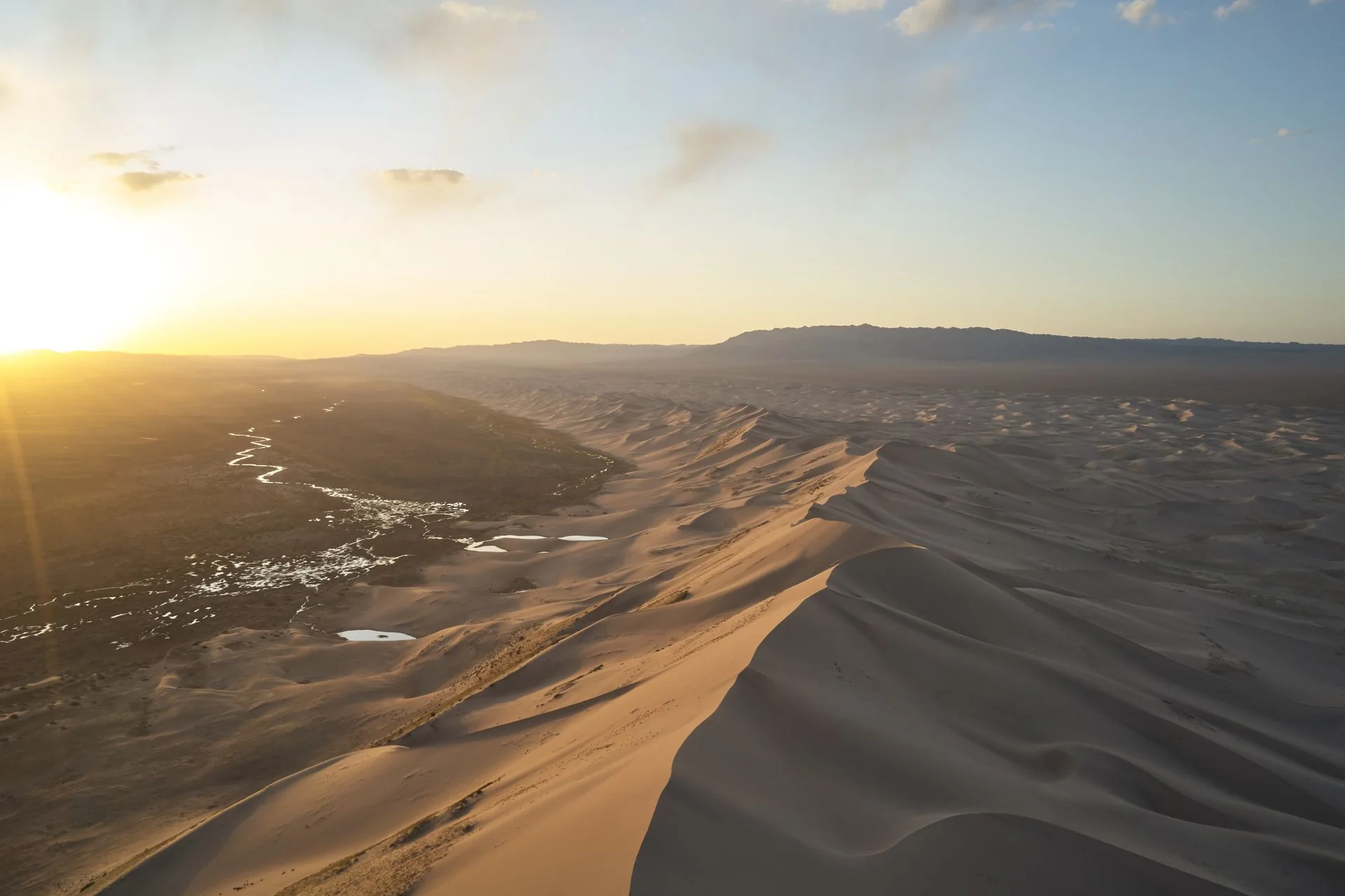
Quick answer: for a first countryside journey, start by comparing mid-June through August. Early September can be a rewarding alternative if you accept colder evenings and confirm accommodation. July suits Naadam-focused travel, while the Gobi deserves its own heat and driving assessment. Winter requires a specifically designed winter itinerary, rather than a summer route with warmer clothes.
Mongolia travel seasons, month by month
Use this table to shortlist dates. These are planning tendencies, not a forecast or a promise that every road and camp will be open. Weather, grass growth and accommodation schedules vary from one year and region to another.
| Month | Planning context | What to confirm |
|---|---|---|
| January | Deep winter; specialist journeys | Heated accommodation, vehicle preparation and a conservative route |
| February | Winter conditions; some cultural travel | The year’s event calendar and actual operating services |
| March | Winter can persist, especially north and at altitude | Snow, ice, thaw conditions and local advice |
| April | A changeable transition with cold and wind | Open camps and a realistic backup plan |
| May | A possible shoulder-season choice | Nights, wind, road access and the exact camp opening date |
| June | A useful starting point for summer countryside travel | Early-month conditions and the full route forecast |
| July | Summer travel and Naadam demand | Festival dates, rooms, vehicles and bookings in writing |
| August | A broad summer planning window | Rain, river conditions, muddy approaches and northern nights |
| September | Autumn scenery and cooler travel | Heating, closing dates and shorter outdoor evenings |
| October | Increasing cold; western festival journeys may be possible | Local event details, transport and winter-capable logistics |
| November | Winter planning becomes central | Route suitability and confirmed services |
| December | Very cold conditions and short outdoor days | Specialist support, insulation and transport contingencies |
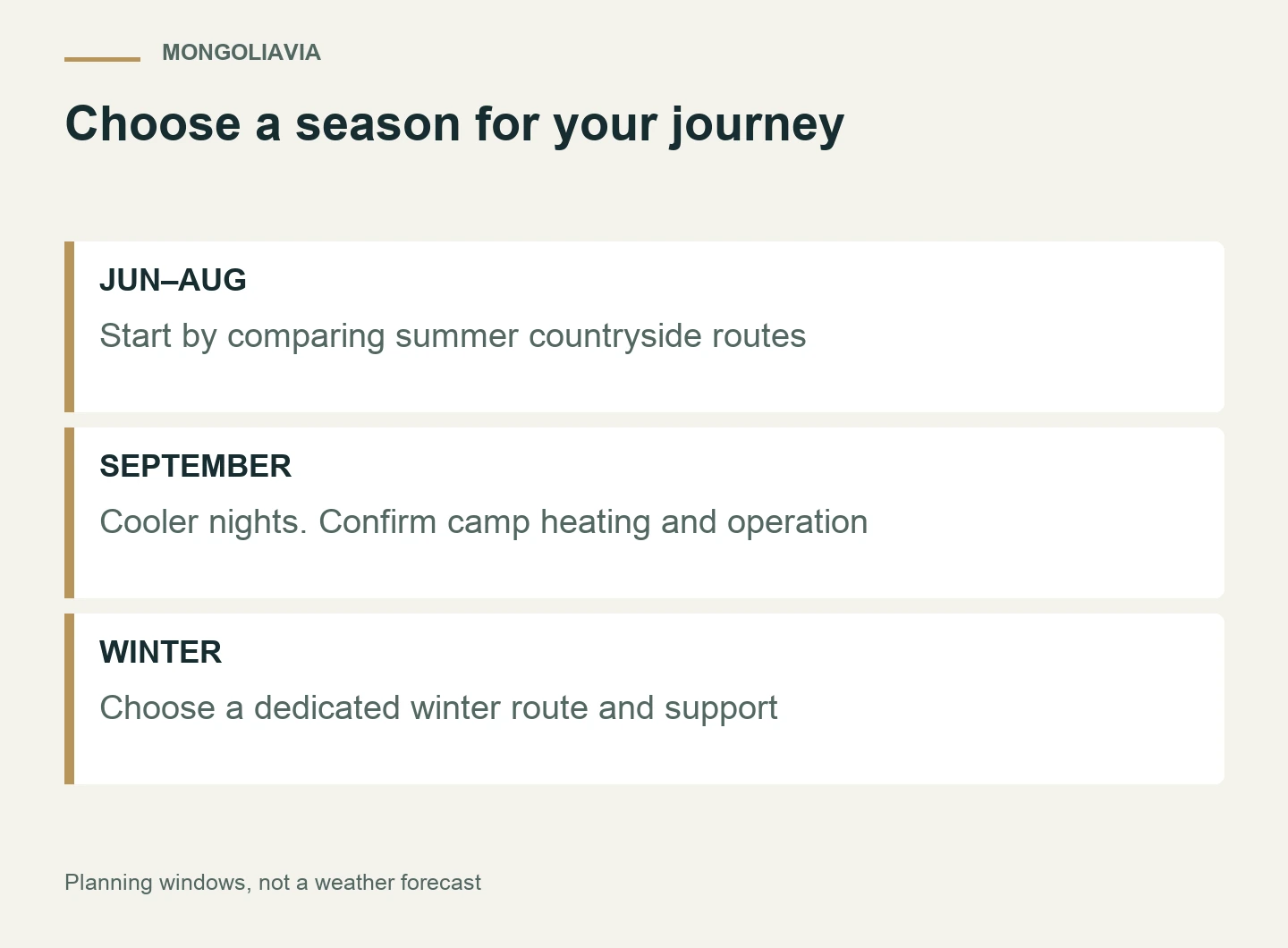
June to August: the easiest starting comparison
Summer offers a wider choice of countryside experiences and longer days for stops. That makes it a useful starting point for first-time visitors, particularly when a trip combines a ger stay, gentle walks and time on the steppe. It does not remove the need for layers, rain protection or a flexible route.
June can appeal if you want to travel before the main July festival demand. July is a different choice if Naadam is your priority. August remains a summer option, but an itinerary should still allow for wet tracks and cool evenings. The practical question is not simply “Will it be warm?” Ask what happens if a road section or an outdoor activity becomes unsuitable that day.
September: distinguish early and late in the month
September should not be treated as one uniform season. A trip in the first week and a trip at the end of the month can need different clothing and accommodation arrangements. Autumn colour and fewer visitors can be attractive, but comfortable daytime sightseeing does not guarantee a warm night.
Get confirmation of the actual ger camp, its heating arrangements, toilets, showers and last operating date. For a northern or high-altitude route, ask how the plan changes if conditions turn cold. A shorter route with reliable overnight stops is often a better autumn decision than collecting more destinations.
May, October and winter: choose the trip for the season
Shoulder-season travel can work well when dates, roads and accommodation fit together. It is a poor choice if the plan relies on camps or experiences that have not confirmed operation. In winter, seek a winter-specific programme with suitable vehicles, overnight arrangements and local support. Do not assume that an attractive summer driving loop is available year-round.
Best time to visit Mongolia by region
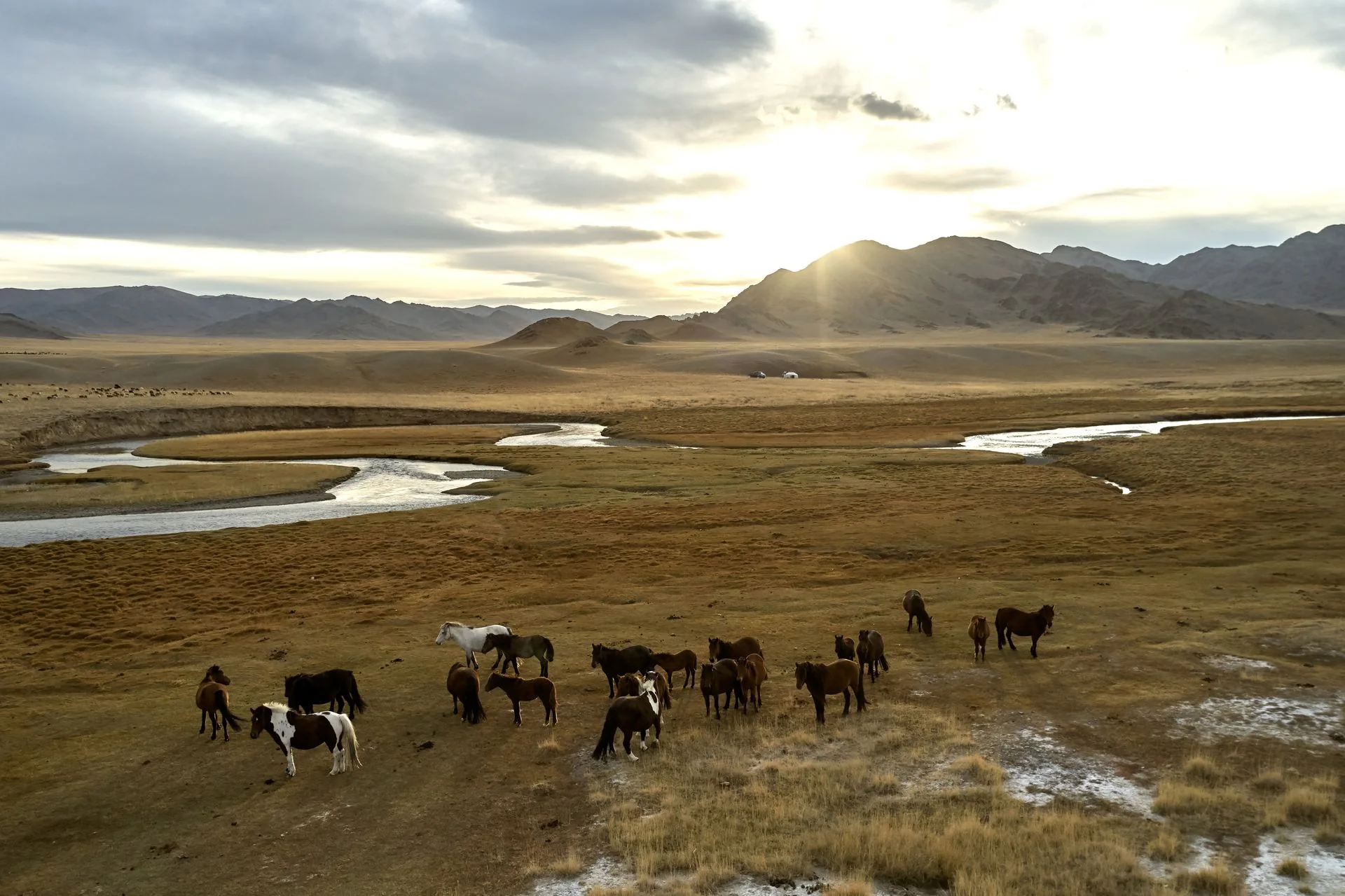
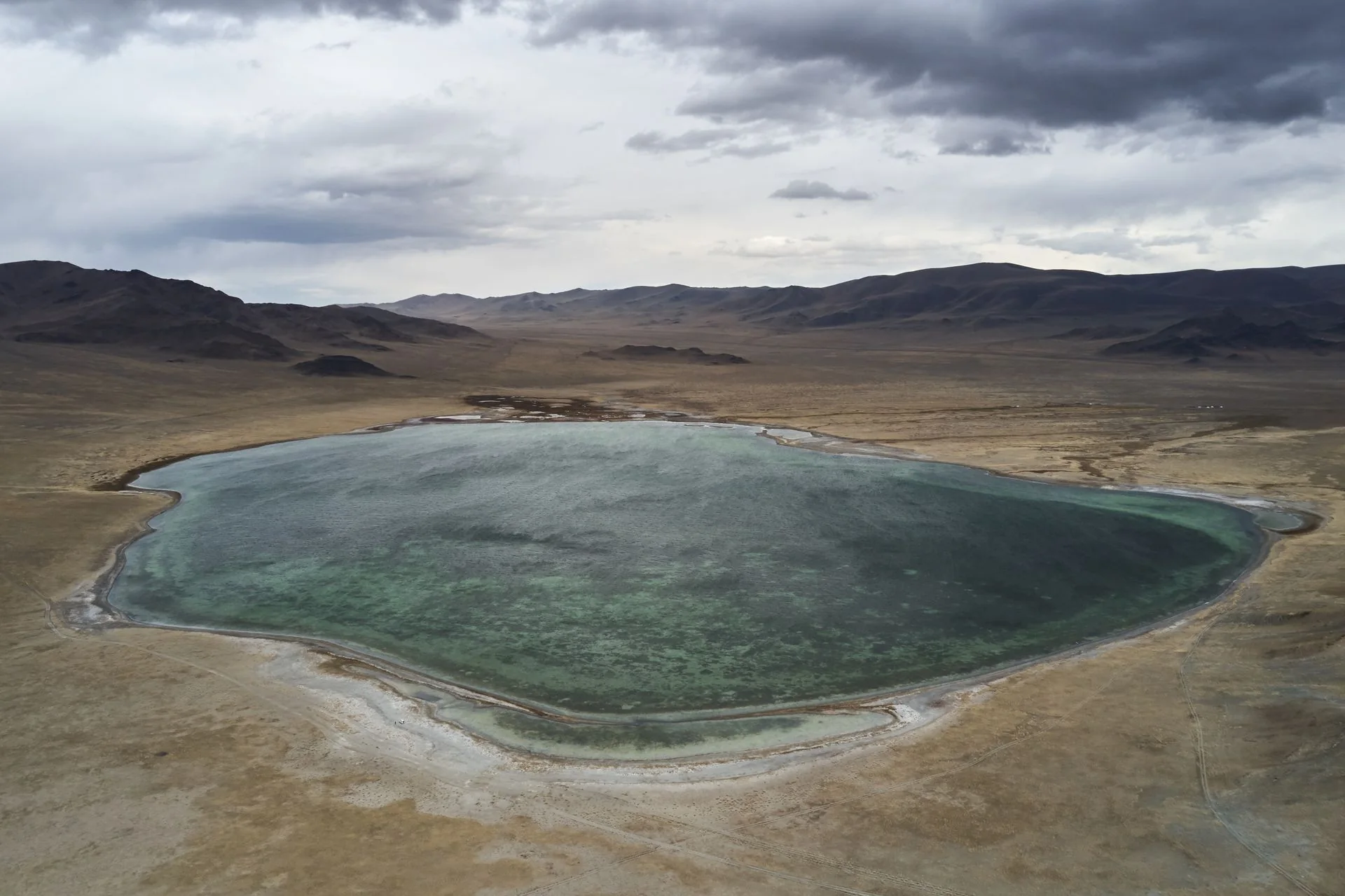
A forecast for Ulaanbaatar is useful for arrival day. It cannot describe every overnight stop in a country of deserts, steppe, lakes and mountains. Check the places where you will actually sleep and the roads between them.
| Region | A useful starting comparison | Questions that improve the plan |
|---|---|---|
| Ulaanbaatar and Terelj | The warmer months, with spring and autumn assessed separately | How much city traffic, walking and time outdoors is involved? |
| Central Mongolia and the Orkhon area | Summer into early autumn, subject to the route | Are the final camp approaches suitable after rain? |
| Southern Gobi | Compare summer with milder shoulder dates | Can exposed walks happen earlier or later in the day, and what are the driving demands? |
| Northern lakes and mountain routes | A shorter summer window deserves careful attention | What are the night conditions, access and confirmed accommodation? |
| Western Mongolia | Match the route to the specific activity or event | Is extra travel time or a domestic connection required? |
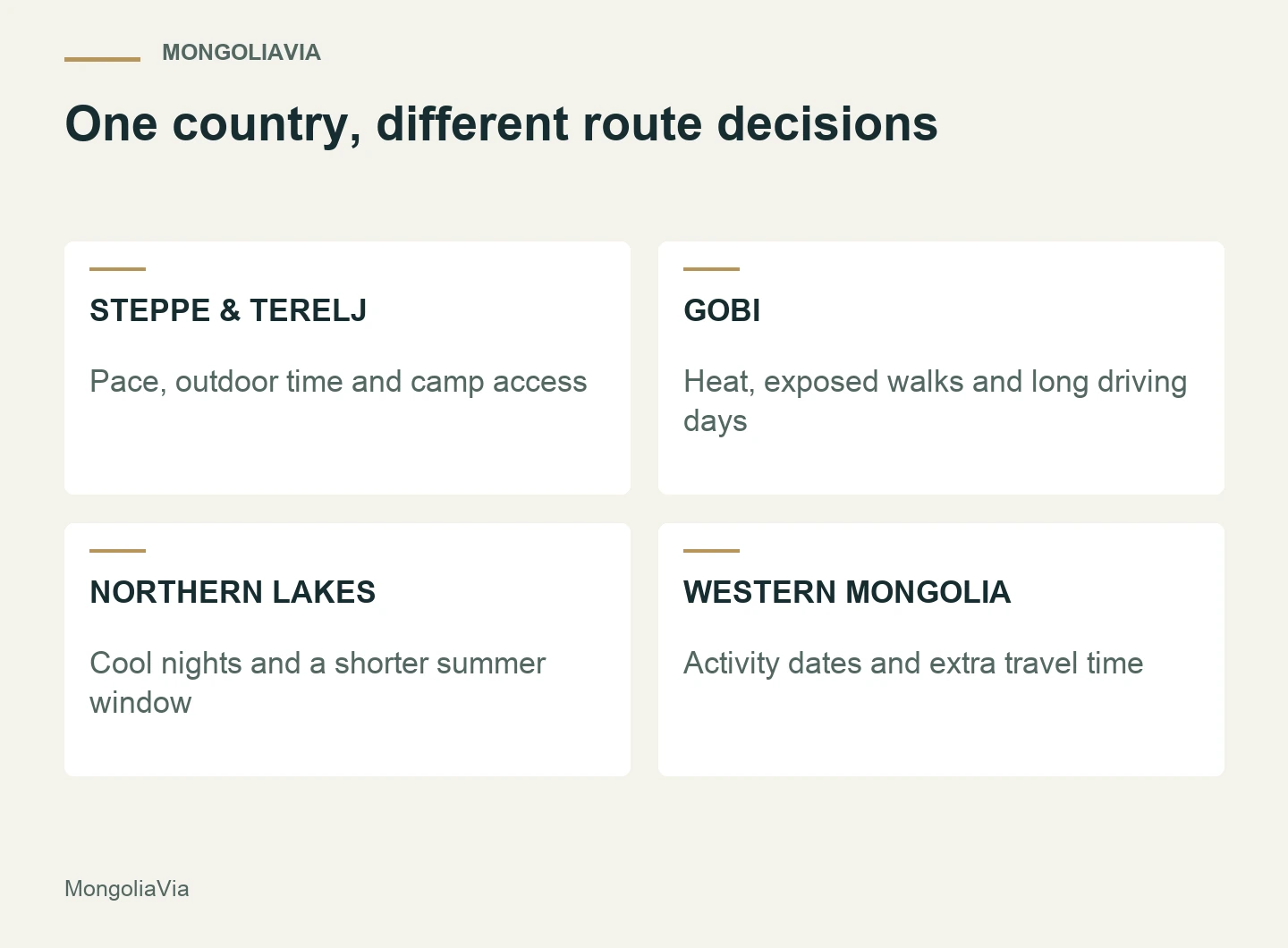
The Gobi is not only sand dunes, and “desert” does not mean uniformly warm nights. Similarly, a northern lake is not a practical add-on to every short Ulaanbaatar trip. Start with the main landscape you care about and build around it. Add another region only after the driver has assessed the road days and the overnight sequence.
Match the season to your available days
Time is as important as the month. A private vehicle makes the itinerary flexible, but it does not shorten Mongolia’s distances. Keep flight days, rest stops, meals and walking time visible when comparing proposals.
| Available time | A sensible discussion starter | A common mistake to avoid |
|---|---|---|
| 2 days | Ulaanbaatar surroundings and a nearby countryside overnight | Trying to turn a distant Gobi highlight into a quick excursion |
| 3 days | A compact nature route with one clear focus | Changing camps every night without checking the driving |
| 5 days | A central-Mongolia loop selected for your pace | Combining several remote regions because they look close on a map |
| 8 days | A more developed Gobi or central itinerary | Treating every day as a sightseeing day when some are travel days |
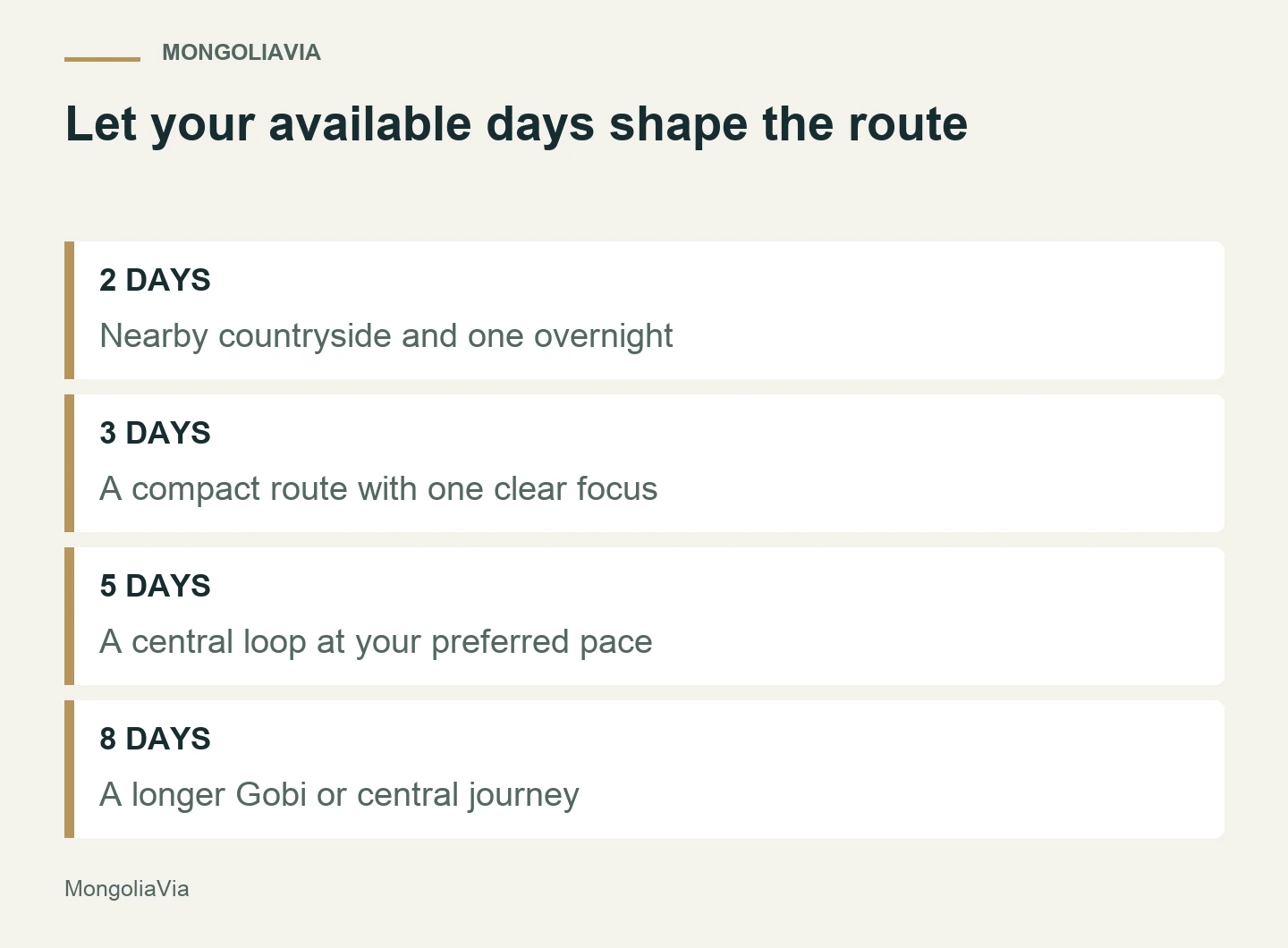
These are starting points, not fixed packages or guarantees of access. Share your flight times and preferred maximum time in a vehicle. If you are travelling with children, older relatives or someone who finds rough roads tiring, discuss shorter days and fewer overnight moves. Ask for the proposed driving sequence rather than judging a quote only by its list of attractions.
Ger camps: opening dates are only the first question
“The camp is open” is not enough information to choose dates confidently. A heated room, hot water hours and the distance to the bathroom can matter more than the daytime weather. Camp facilities differ, and a photograph of a comfortable ger does not confirm the arrangements for your stay.
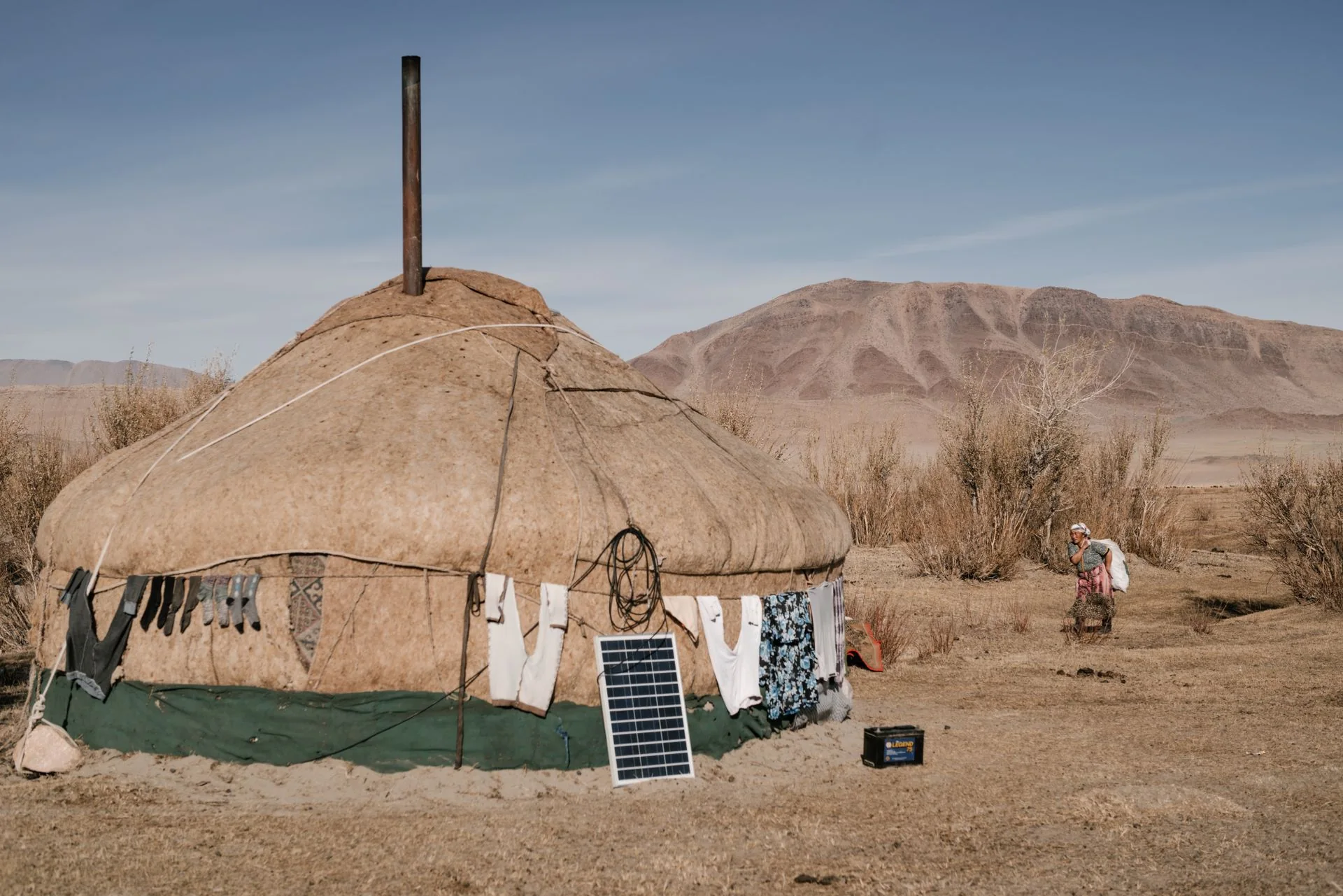
Before booking, ask about:
- The named camp and its operation on your exact nights.
- Bedding, insulation, heating and who manages any stove.
- Private or shared toilets and showers, including hot water hours.
- Electricity and charging access, rather than assuming an all-night supply.
- The meal plan, dietary needs and drinking water arrangements.
- A fallback overnight stop if weather prevents the planned access.
Do not operate unfamiliar heating equipment yourself. Request clear instructions from camp staff, and keep a warm layer and light accessible for an evening walk to shared facilities. Our packing guide explains how to prepare without filling your luggage with unnecessary equipment.
Naadam, photography and stargazing
If a festival determines your dates
Naadam is associated with July, but the event, venue and local programme must be checked for your travel year. Western eagle-festival journeys require a separate location and transport plan. Confirm the actual event you want to attend before arranging flights around a general seasonal description. Tickets, accommodation, guiding and festival transfers should be specified separately in your proposal.
If clear skies are the priority
No month guarantees stars. Cloud, moonlight, wind and the location of a camp affect the experience. If night photography matters, discuss moon phase, safe access after dark and whether the day’s driving allows an unhurried evening. A tripod is useful only if you are willing to carry it and there is an appropriate place to use it.
A practical booking sequence
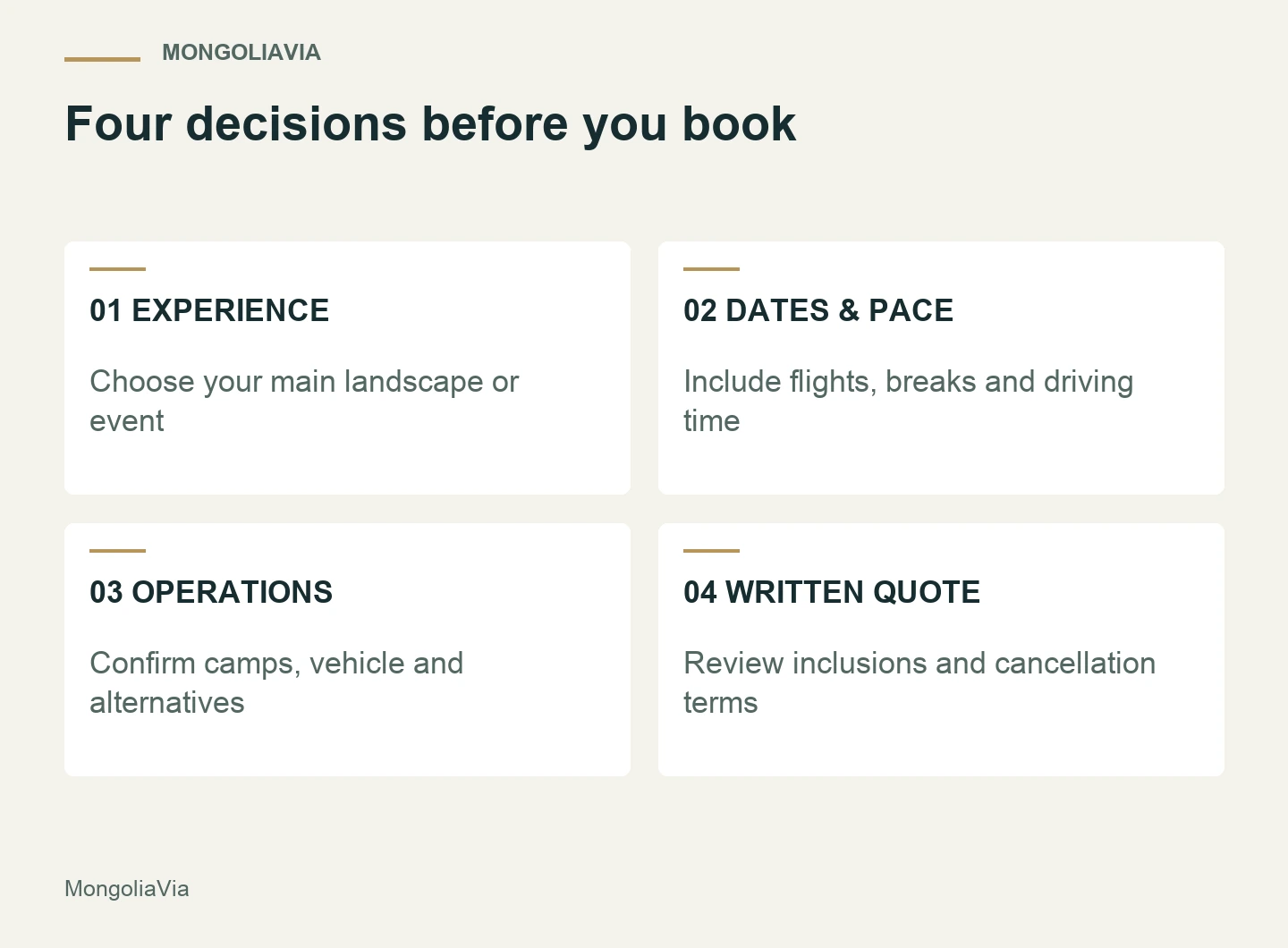
- Choose your main experience. Steppe, Gobi, a northern lake or a particular festival.
- Set a date range and a realistic pace. Include arrival, departure and recovery time after long travel.
- Confirm the operating details. Route, camps, vehicle, luggage, language support and weather alternatives.
- Review the written quote. Check inclusions, daily use, driver expenses, accommodation and cancellation terms before committing.
The MongoliaVia model itineraries are route ideas, while the price page explains the starting-price structure. The final amount depends on dates, the driver’s qualifications and experience, the vehicle and the itinerary. Meals, camps, admission, guiding and activities are included only when your written quote says so.
For travellers arriving from the United States, separate the international journey from the first countryside driving day. For Singapore, Hong Kong, Australia and Korea, do not assume that a school or public-holiday period coincides with Mongolia’s gentlest weather. Flight schedules and connections should be checked for your actual dates.
Frequently asked questions
What is the best month for a first Mongolia trip?
Compare June, July and August first, then early September if cooler nights suit you. The most suitable month is the one that fits your chosen region, accommodation and pace. A festival-focused trip may have a narrower date requirement.
Is Mongolia too hot in July?
Conditions depend on the region and the day. The southern Gobi deserves a specific heat assessment and a sensible schedule for exposed activities. Choose suitable clothing, shade and breaks, and retain the option to change an activity.
Is September suitable for a ger stay?
It can be, provided the actual camp is operating and its bedding, heating and facilities meet your needs. Confirm the overnight arrangements rather than relying on a country’s average daytime temperature.
Does travelling off season always cost less?
No. Fewer visitors do not automatically mean a lower total. Longer transfers, limited accommodation, specialist vehicles or extra support can change the cost. Compare the same route and inclusions in a written quote.
Can a private driver guarantee access to every stop?
No. A driver can assess conditions and discuss alternatives, but weather and road access remain variable. A useful itinerary includes fallback stops and reasonable time for changes.
What should I check just before departure?
Review forecasts for each overnight area, current official travel advice, your camp confirmations and the latest route assessment. The WMO weather service and official travel advice are useful starting points; a seasonal guide is not a live forecast.
Tell MongoliaVia your dates, group size, luggage and the landscapes you most want to see. Request a personal itinerary and quote to turn the season you prefer into a practical journey.
A useful Mongolia packing list should fit your route, season and overnight arrangements. It should not turn a two-night ger trip into a mountaineering expedition, or assume that a vehicle-and-driver booking includes every camping item. The aim is to keep the essentials close, prepare for changing conditions and confirm what is supplied before you buy more equipment.
Start with five things: adaptable layers, comfortable closed footwear, protection from sun and wind, a small day bag and written confirmation of your camp facilities. Then add items for your actual activities. A traveller staying in staffed camps needs a different kit from someone on an unsupported camping expedition.
Mongolia packing list: the essentials at a glance
Treat the quantities below as a starting checklist for a short private road trip, not a baggage allowance. Adjust for trip length, laundry access, your own needs and the forecast. Check airline and vehicle limits separately.
| Group | Pack or arrange | Why it earns space |
|---|---|---|
| Documents | Passport, required entry documents, insurance and offline booking details | Keep essential information available without mobile data |
| Base clothing | Comfortable tops, long trousers, underwear and enough socks | Useful for walking, driving and changing temperatures |
| Warmth | A fleece or similar mid-layer, an insulating outer layer appropriate to the season | Evening stops and mornings can differ greatly from midday |
| Weather protection | A wind-resistant waterproof shell, sun hat and sunglasses | Sun, wind, dust and rain need different responses |
| Footwear | Worn-in closed walking shoes and camp or shower footwear | Avoid relying on one pair for every activity |
| Day bag | Water, layers, personal essentials, light and a small rubbish bag | Reach them without unloading the main luggage |
| Camp items | Headlamp, personal toiletries and a quick-drying towel if not provided | Shared facilities and charging arrangements vary |
| Devices | Compatible chargers, an appropriate adapter and a permitted power bank | Plan for equipment requirements and limited charging opportunities |
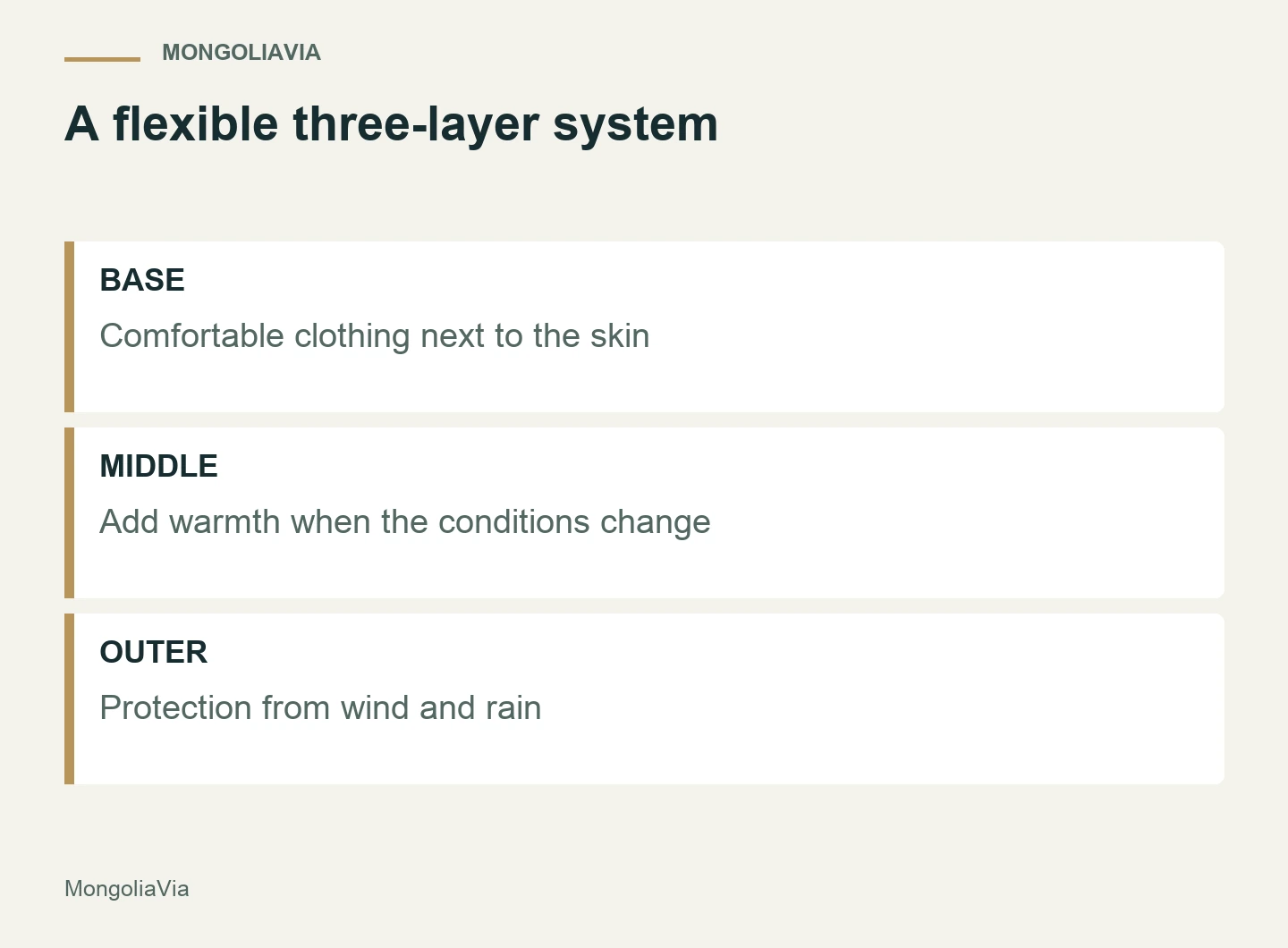
Dress for a changing day
A comfortable base layer, a warmer mid-layer and a weather shell give you more options than one heavy outfit. Keep the extra layer in the passenger area rather than at the bottom of your main bag. Clothing that is comfortable while seated also matters on a long driving day.
Summer packing still needs a warm option. In spring, autumn, northern areas or at altitude, ask whether your insulation is adequate for the expected nights. Winter is a separate packing exercise requiring a winter itinerary and appropriate equipment. Do not use this general short-trip list as a complete winter or technical-trekking kit.
Separate your day bag from your main luggage
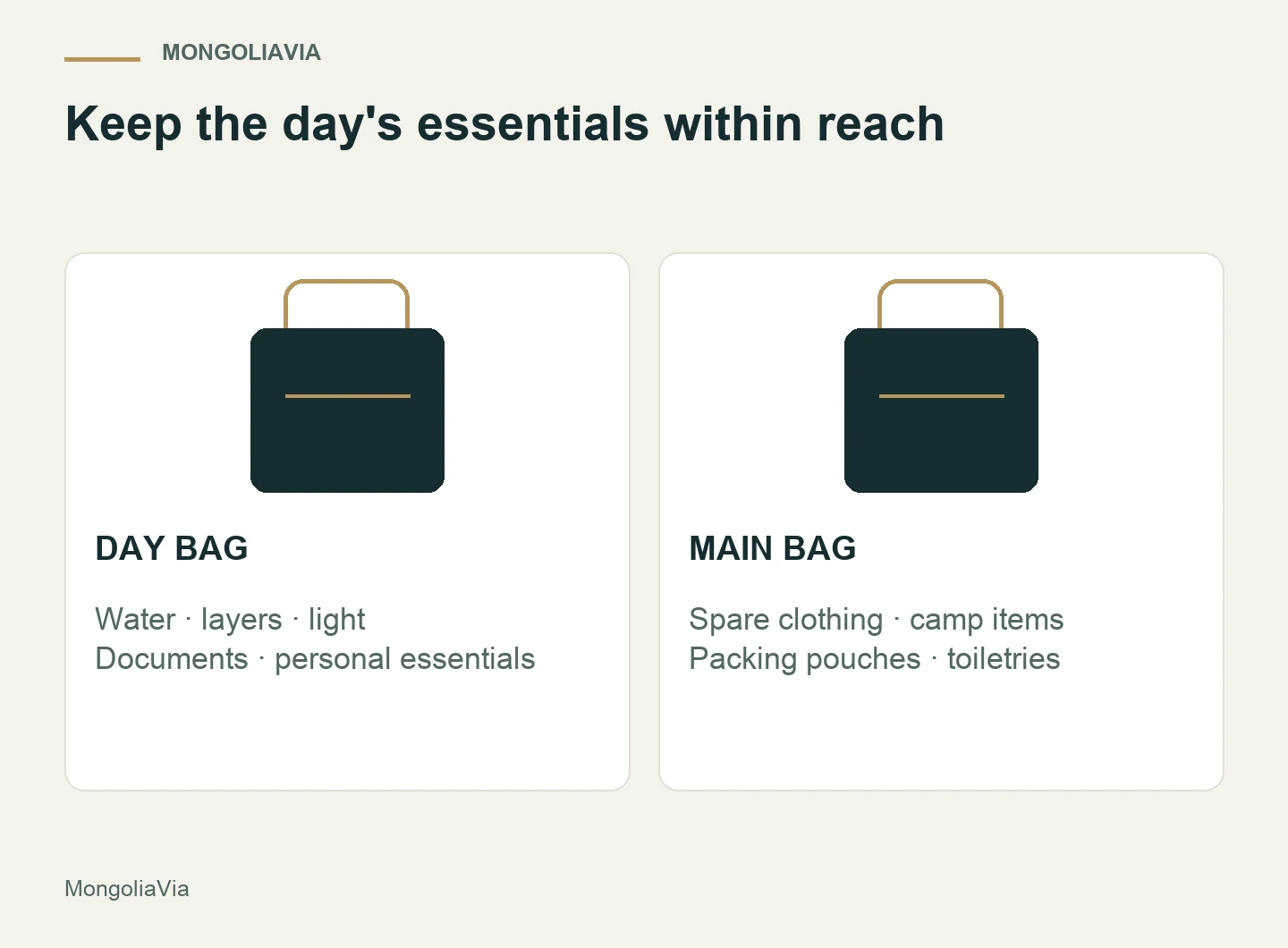
Put the things you might need before the next overnight stop into a small day bag. That usually includes a warm layer, rain shell, water, sun protection, medication you personally require, camera or phone, charging cable, tissues and a light. Keep travel documents and valuables secure and accessible to you.
The main bag holds spare clothing, non-essential toiletries and items needed only at camp. A soft bag is often easier to arrange around other passengers’ luggage, but it is not a universal requirement. Send the vehicle organiser the number, dimensions and type of bags before booking. Seats available and luggage capacity are different questions.
For a 2–3 day trip, avoid packing several alternative outfits for each day. For 5–8 days, plan underwear and socks around the actual laundry opportunities rather than assuming that everything can be washed and dried every evening. Use small packing pouches so you can reach one item without emptying the vehicle.
What to bring for a ger camp
Facilities vary more than the word “ger” suggests. Some stays provide substantial bedding and private facilities; others use shared bathrooms and limited charging or hot water hours. A luxury label alone is not a packing specification.
| Confirm before you pack | What the answer changes |
|---|---|
| Bedding and heating | Whether extra sleep insulation or a liner is useful |
| Private or shared bathroom | Camp footwear, a towel and a small wash bag |
| Electricity hours and sockets | Charging order, adapter needs and camera batteries |
| Drinking water and meals | Bottle use, suitable snacks and dietary arrangements |
| Provided activity equipment | Whether you need to source a suitable helmet or other gear |
| Luggage storage | Whether a large suitcase should remain at your Ulaanbaatar hotel |
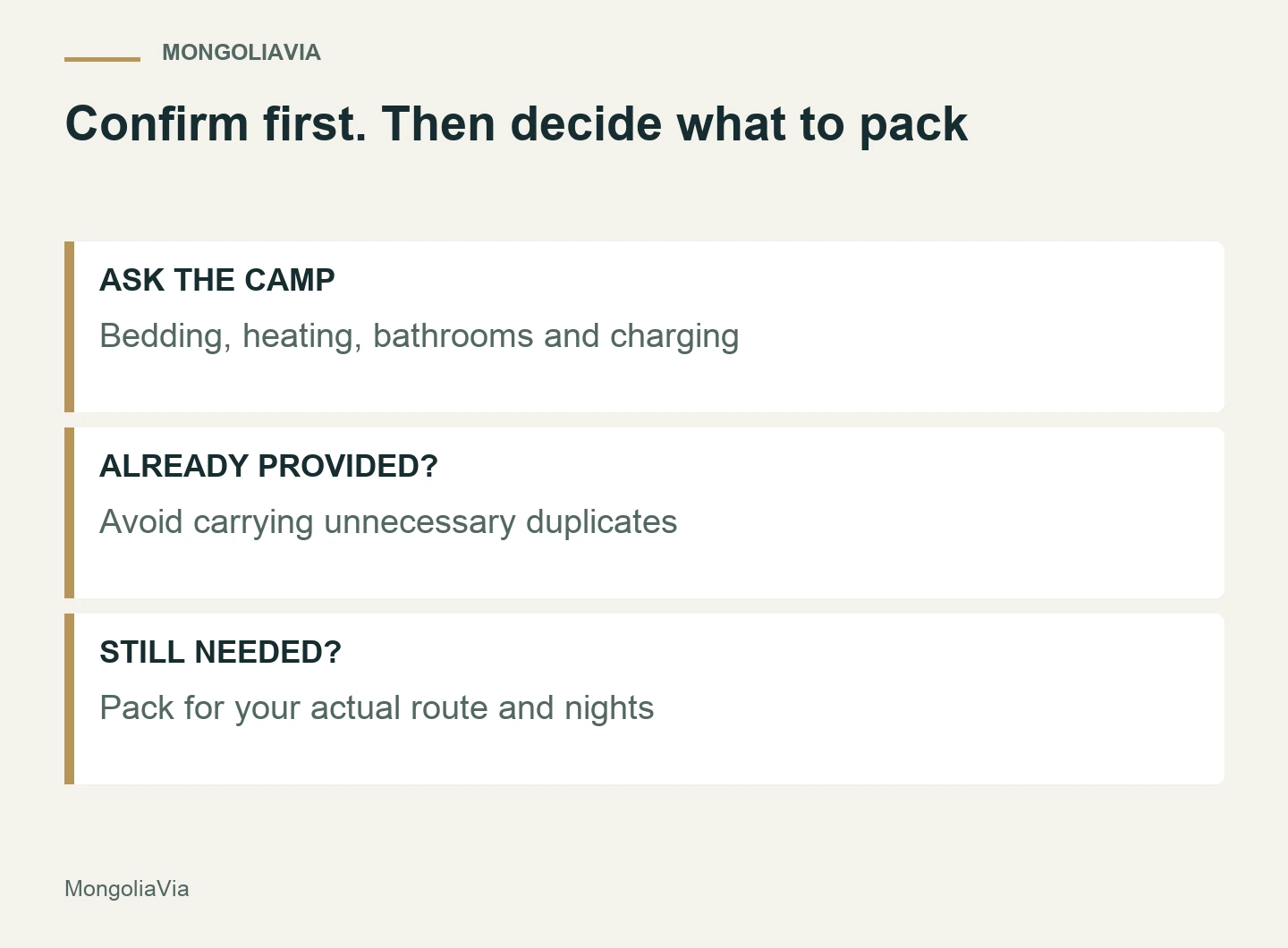
Do you need a sleeping bag?
Not automatically. First ask exactly what bedding is provided, what the night conditions may be and whether you are staying in a camp or independently camping. If a sleeping bag is recommended, discuss its comfort rating for the expected conditions. A generic instruction to bring a bag does not establish that it will keep you comfortable.
A small camp kit that is easy to use
A headlamp keeps your hands free on the way to shared facilities. Camp or shower footwear, a wash bag, tissues and a towel when needed can be more useful than bulky gadgets. Ask staff how heating equipment works, keep clothing away from hot surfaces and follow the camp’s instructions rather than tending an unfamiliar stove yourself.
Adjust the list to the landscape
Gobi road trips
Keep sun protection, sunglasses and a light face covering for dusty conditions accessible. Protect camera equipment inside a bag when it is not in use. Discuss drinking water supply and resupply with your organiser before leaving the city; carrying a bottle does not by itself solve a remote route’s water needs. A long, exposed dune walk is optional, not a reason to ignore heat, wind or your comfort.
Northern lakes and grassland routes
Plan for cool evenings, possible wet ground and seasonal insects. Bring footwear suitable for the walks you actually intend to take. A remote lake stay may have different facilities from a camp near the capital, so recheck each overnight stop rather than assuming one answer covers the entire itinerary.
Horse riding and other activities
Tell the organiser your experience level, age or any relevant fit requirements. Check that appropriate protective equipment and local supervision are available before confirming. Clothing should allow comfortable movement and footwear should be suitable for the specific activity. Do not assume that being a passenger on a private vehicle tour automatically makes riding equipment part of the booking.
Electronics, offline information and personal items
Download the itinerary, accommodation details, meeting instructions and useful maps before you leave reliable connectivity. Save the driver’s contact details and an agreed plan for a missed meeting. Mobile coverage can be limited in rural areas; an ordinary phone or power bank is not a substitute for a route’s communications and emergency arrangements.
Check the voltage and input range printed on your devices, the adapter you need and what the accommodation actually provides. An adapter changes a plug connection; it does not automatically convert voltage. Prioritise charging important devices when electricity is available instead of assuming the supply continues throughout the night.
Power banks and spare lithium batteries belong in hand baggage, with terminals protected. Confirm your own airline’s size, quantity and use rules before flying, including any domestic sector. See IATA’s battery guidance. Avoid buying a large new power bank just because a packing list recommends one.
Keep regular personal medication in its original labelled packaging and check any entry requirements with the relevant authority. Discuss personal health questions with your clinician. A modest personal kit does not replace medical or evacuation planning for a remote itinerary.
Pack less by confirming more
Leave expedition tents, fuel containers, recovery equipment and bulky cooking supplies off a standard passenger’s shopping list unless they are explicitly part of your agreed role. Those items belong in a discussion about how the trip is organised. Ask which vehicle equipment, drinking water, activity items and overnight supplies are provided, and identify anything still unconfirmed.
Food and gifts also deserve thought. Request meal arrangements and tell the organiser about allergies or dietary needs before departure. Check current customs rules before bringing food across a border. If visiting a family, ask what is appropriate rather than assuming sweets or unsolicited gifts are welcome. Carry out your rubbish and minimise disposable packaging.
Your final departure checklist
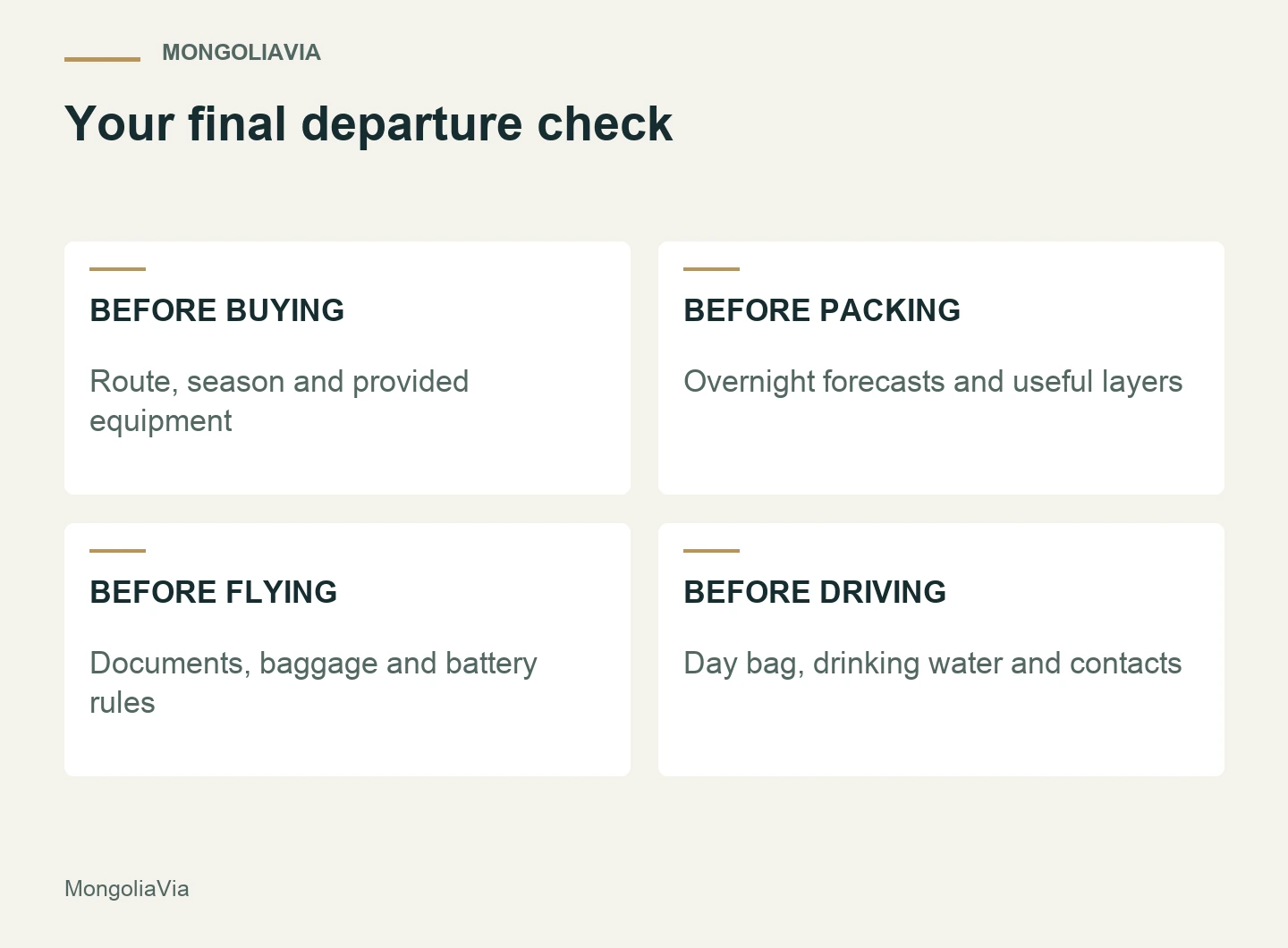
- Before buying equipment: confirm route, season, camp bedding, bathrooms and what is included.
- Before closing the bag: check the forecast for overnight locations, not only Ulaanbaatar; remove unnecessary duplicates.
- Before flying: confirm airline baggage and battery rules, documents and permitted personal items.
- Before the countryside drive: place your day bag within reach and reconfirm water, meeting details and communications.
For a private vehicle quote, tell MongoliaVia the number of people, bags and nights, plus any riding, walking or photography plans. Luggage capacity, child-seat needs, vehicle suitability and language support should be confirmed for your specific booking. Ask about your route and packing needs.
Frequently asked questions
Can I take a hard suitcase to Mongolia?
Possibly. The important factors are the vehicle, passenger count, other luggage and overnight logistics. Share dimensions in advance. A soft bag may be easier to stow, but there is no single suitcase rule for every Mongolia trip.
Do I need hiking boots for a short ger trip?
Choose footwear for the activities and terrain, and use something already comfortable. A city visit and a gentle camp walk do not require the same footwear as a technical hike. Ask about the route before buying heavy boots.
Should I bring towels and bedding?
Only after checking what each overnight stay provides. A quick-drying towel or liner may be useful; a bulky blanket may simply take up space. A description such as “ger accommodation” does not settle the question.
Is a phone torch enough?
A headlamp is a convenient hands-free option for camp facilities, especially when you also need your phone’s battery for maps and contact details. Carry a light you can use easily and follow camp guidance after dark.
Can I buy missing items on the route?
Do not build the plan around it. You can discuss shopping in Ulaanbaatar, but the availability, opening hours and stock of rural stops vary. Obtain essential personal items before setting out.
Is this a winter packing list?
No. It is a general framework for short private countryside trips, mainly in the warmer travel months. Winter, high-altitude trekking and independent expeditions require a dedicated list and appropriately organised support. Compare the season guide before choosing dates.
For road conditions and communications context, check current official travel advice. Then use the model itineraries to discuss a route that fits your time and the luggage you actually need.
WordPress へようこそ。こちらは最初の投稿です。編集または削除し、コンテンツ作成を始めてください。